
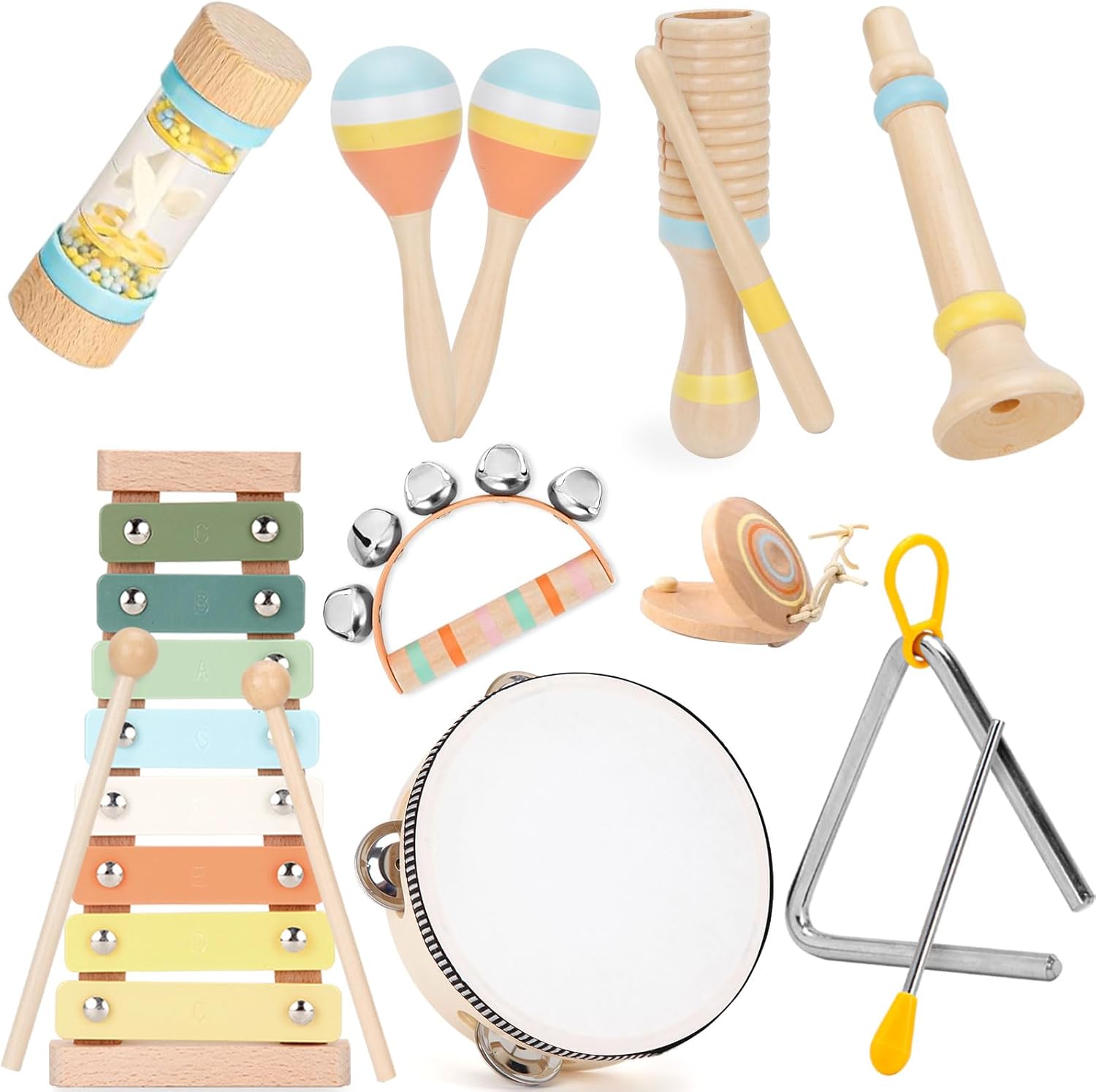
Around the first birthday, something subtle but powerful is happening inside a baby’s brain. Connections are firing at an astonishing rate. Sounds carry meaning. Actions begin to feel intentional. Curiosity turns physical.
This is why baby musical instruments for 1 year old children matter far more than most parents realize.
Music isn’t a bonus activity at this age. It’s a bridge—between movement and thought, emotion and expression, instinct and understanding. When a one-year-old taps a drum or shakes a rattle, they aren’t performing. They’re experimenting. Testing. Learning how the world responds to them. [ see lowest price]
And that matters.
What a 1-Year-Old Is Really Learning Right Now
At twelve months, babies live in a space where understanding is growing faster than language. They feel patterns before they can explain them. Rhythm before rules.
Early Language Begins With Sound
Most one-year-olds are still months away from clear words, but their brains are already tuned to:
-
Tone and pitch
-
Repetition and pauses
-
Cause-and-effect sound patterns
Musical instruments support this phase naturally. A baby who bangs a drum, pauses, and bangs again is learning timing. A baby who vocalizes after hearing a sound is practicing early communication—long before sentences arrive.
Music gives language a structure before vocabulary ever appears.
Why Rhythm Builds Cognitive Strength
Patterns are everywhere in music. Fast. Slow. Loud. Soft.
When babies interact with musical toys, they begin predicting outcomes. That prediction strengthens memory, attention, and problem-solving skills. These early rhythm experiments quietly support math reasoning, language flow, and focus later on.

What Science Tells Us About Music and the Baby Brain
Music is one of the few activities that lights up multiple regions of the brain at the same time. For babies, this is incredibly valuable.
Hands-on musical play:
-
Strengthens neural connections
-
Supports coordination between brain hemispheres
-
Engages emotional and motor centers together
Unlike passive toys, musical instruments for toddlers demand interaction. Movement creates sound. Sound invites reaction. Reaction creates learning.
That loop—action, feedback, adjustment—is how babies build understanding.
Check Today’s lowest Price For Baby Musical Instruments
Key Skills Musical Instruments Build Between 12 and 18 Months
Fine Motor Control and Coordination
Gripping a mallet. Shaking a bell. Tapping a surface.
These small movements refine:
-
Hand strength
-
Precision
-
Spatial awareness
The same skills later used for stacking blocks, turning pages, drawing, and writing begin here.
Clear Cause-and-Effect Learning
Musical toys are honest. Do something, hear something.
That clarity builds confidence. Babies learn that their actions matter. That intention leads to outcome. Few toys teach this lesson as cleanly or joyfully as music.
Emotional Expression Without Words
Babies feel big emotions but don’t yet have the language to release them.
Music helps.
-
Fast tapping can release excitement
-
Gentle shaking can calm
-
Repetition can soothe
Over time, babies begin using sound as a form of emotional regulation—long before they can explain how they feel.

The Best Baby Musical Instruments for 1-Year-Olds
The most effective musical instruments for this age share three qualities:
-
Simplicity
-
Safety
-
Responsiveness
Drums and Soft Percussion
Drums feel instinctive. No instructions needed.
They encourage:
-
Gross motor movement
-
Rhythm exploration
-
Emotional release
Soft or fabric-covered drums help manage volume while keeping play engaging.
Xylophones and Mallet Toys
Xylophones introduce pitch differences while encouraging control.
They support:
-
Hand-eye coordination
-
Early sound differentiation
-
Focus through repetition
For one-year-olds, tethered mallets and rounded edges are essential.
Shakers, Bells, and Rhythm Toys
Shakers are often a baby’s first instrument—and for good reason.
They respond to natural movement, reinforcing:
-
Body awareness
-
Timing
-
Sensory feedback
Wooden or fabric-covered options tend to produce gentler, more pleasant sounds.
Montessori and Sensory-Based Musical Play
Montessori-style musical instruments focus on realism and purpose. No flashing lights. No automated songs. Just materials that respond honestly to touch.
This kind of play:
-
Encourages independence
-
Builds focus
-
Allows babies to explore at their own pace
Sensory-based music play also supports different learning styles by engaging touch, sound, and movement together—making it especially effective for early development.

How Often Should a 1-Year-Old Use Musical Instruments?
There’s no need for schedules or structure.
Short, consistent sessions—five to fifteen minutes—are ideal. Musical play works best when:
-
Integrated into daily routines
-
Shared with a caregiver
-
Used intentionally, not as background noise
Active engagement always matters more than duration.
Click Here For -16% Discount Now!
FAQs
Are baby musical instruments safe at one year old?
Yes, when designed for babies. Look for non-toxic materials, smooth edges, and age labeling.
Can musical toys be overstimulating?
They can be if overly loud or electronic. Simple, acoustic-style instruments are usually best.
Do babies need lessons or structure?
No. Exploration beats instruction at this stage.
Are electronic musical toys bad?
Not inherently—but toys that respond directly to a baby’s actions offer more developmental value.